Turning Circle-based
Control Barrier Function
for Efficient Collision Avoidance
of Nonholonomic Vehicles
1Kongju National University · 2KAIST


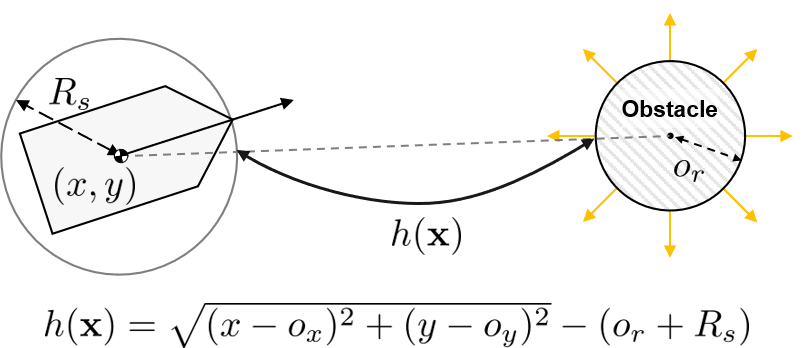
Distance constraints in MPC (MPC-DC)
Distance constraints need a long horizon
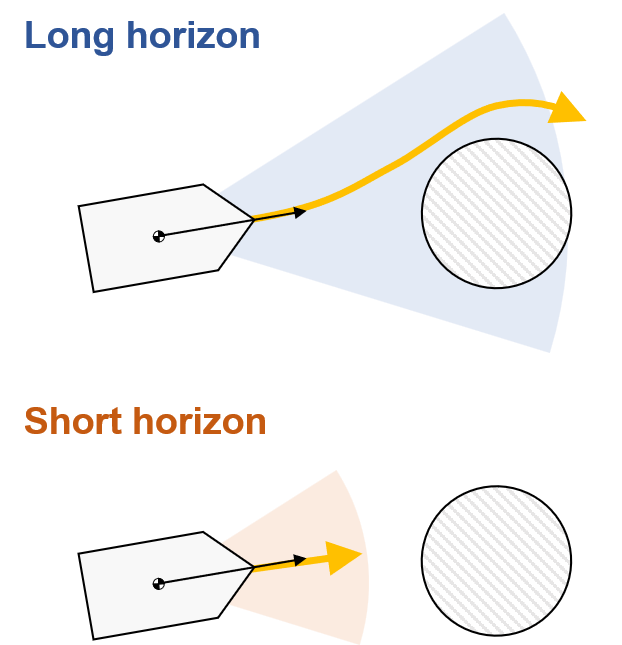
Same scenario — only the prediction horizon of MPC-DC differs
→ MPC-DC requires a long prediction horizon, which increases the computational load
CBF constraints in MPC (MPC-CBF)
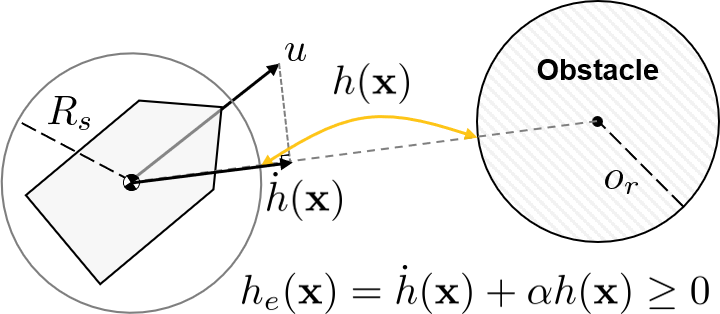
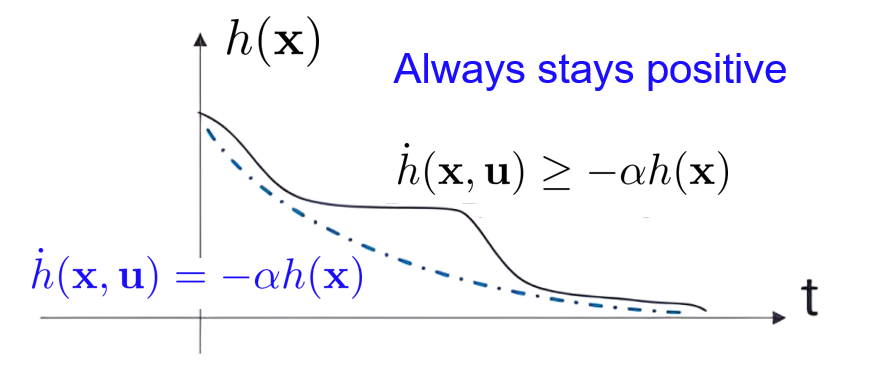
- The CBF limits the speed toward an obstacle in proportion to the relative distance from it
- MPC-CBF with a shorter horizon can still achieve performance similar to MPC-DC [1]
ED-CBF overlooks heading and turning
ED-CBF values for a circular obstacle
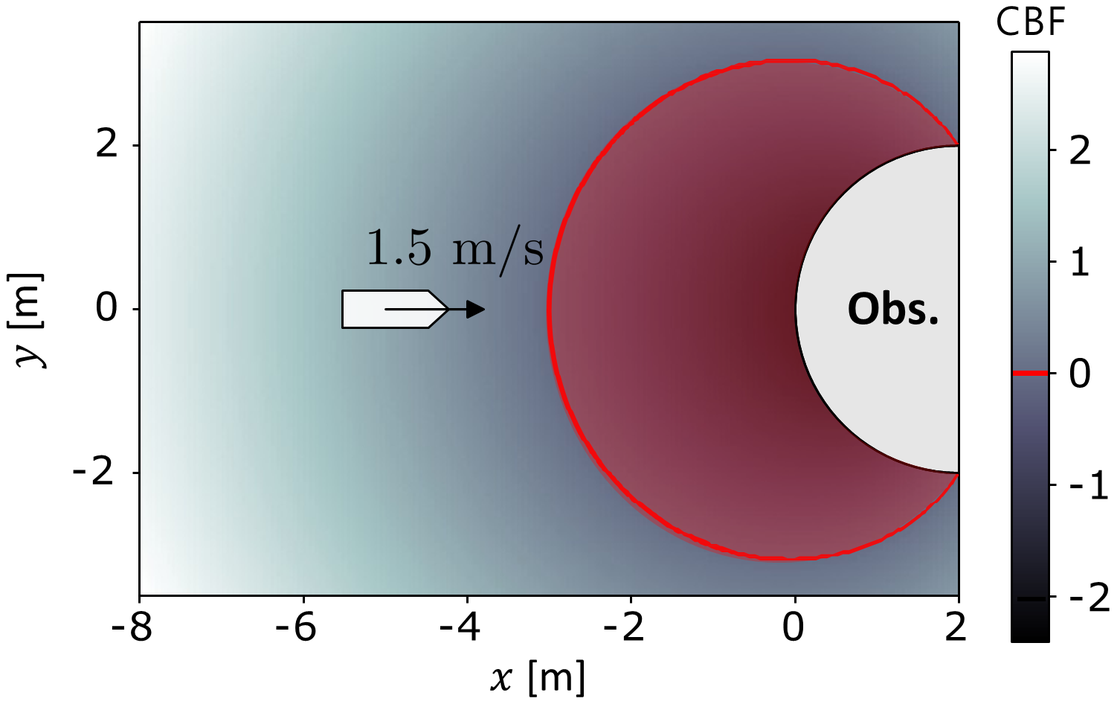
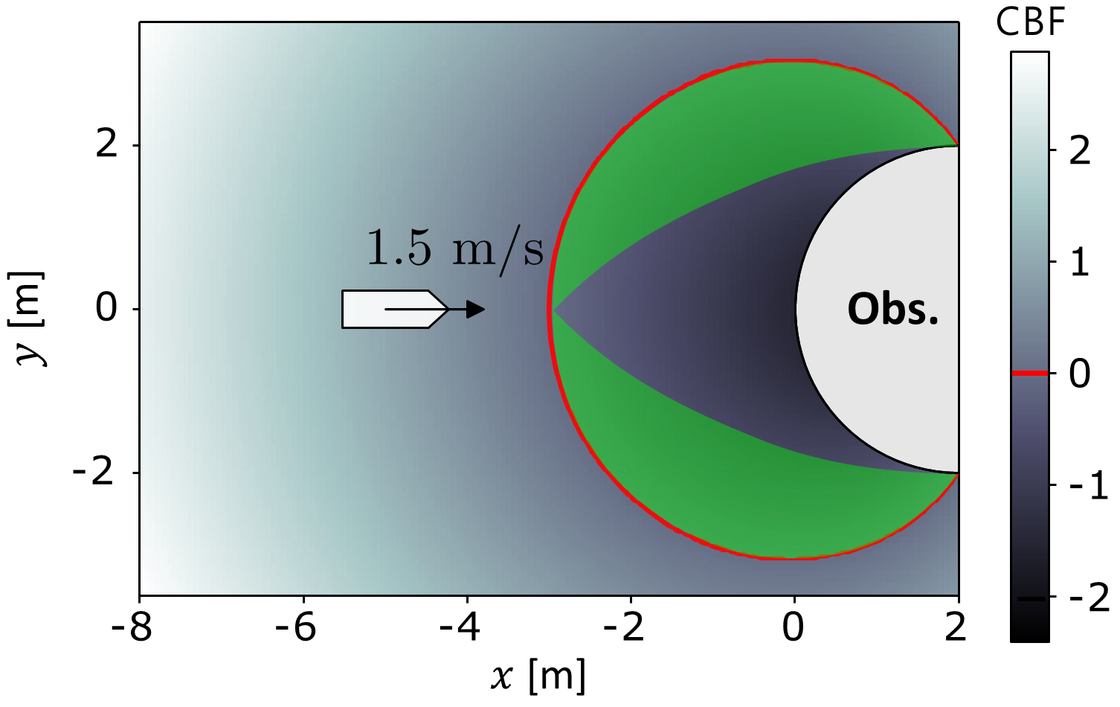
Only the closest Euclidean distance
Conventional CBFs measure the shortest distance to the obstacle — the ED-CBF
Heading and turning are ignored
Limited turning capability is a common characteristic of nonholonomic vehicles — cars, robots, ships
Safe states are perceived as risks
States that are actually safe for navigation are restricted → conservative trajectories
Nonholonomic characteristics in the CBF design → Turning Circle-based CBF (TC-CBF)
TC-CBF restricts far fewer states
ED-CBF
conventional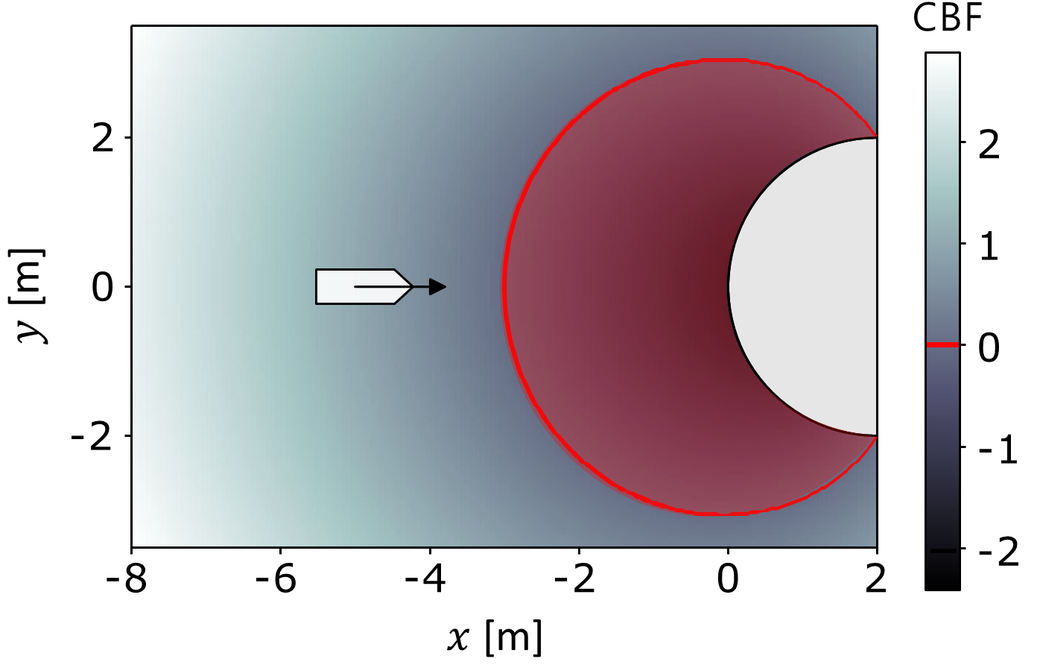
TC-CBF
proposed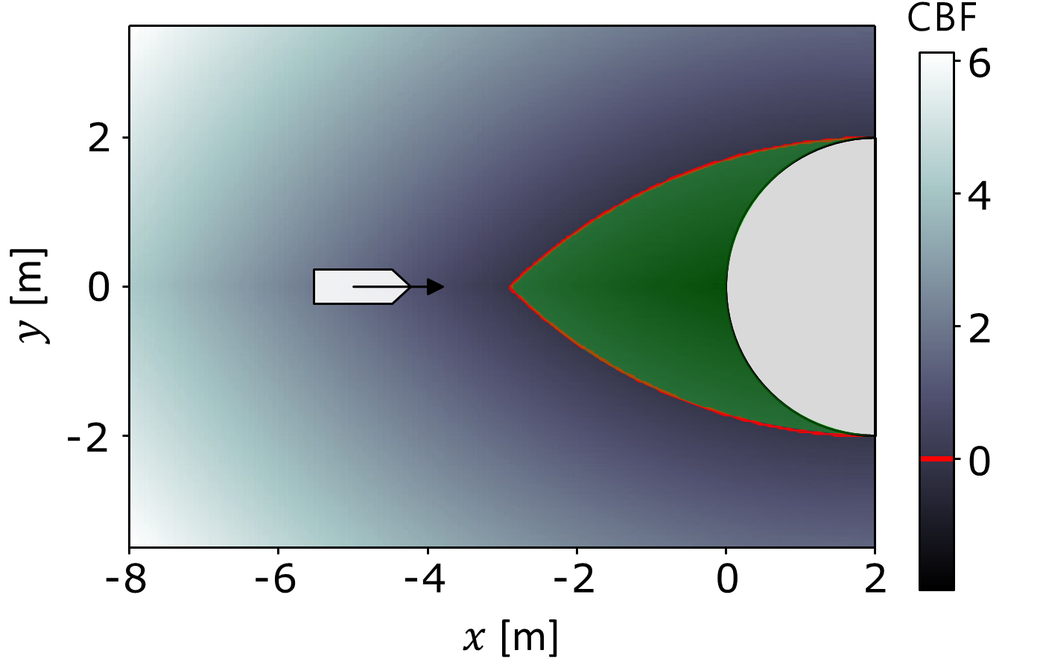
ED-CBF stays conservative after tuning
Even with different parameter sets, ED-CBF generates more conservative trajectories than TC-CBF due to its inherent characteristics
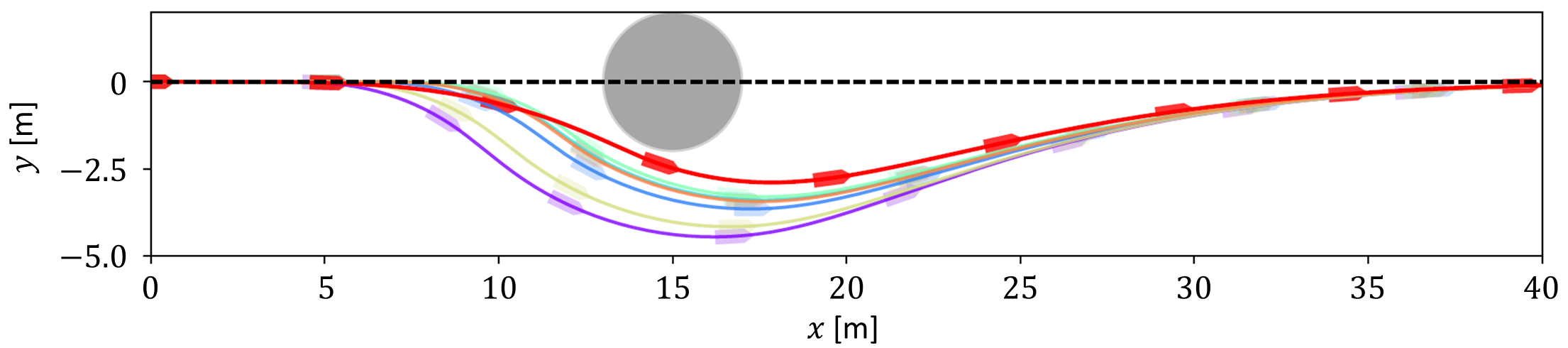
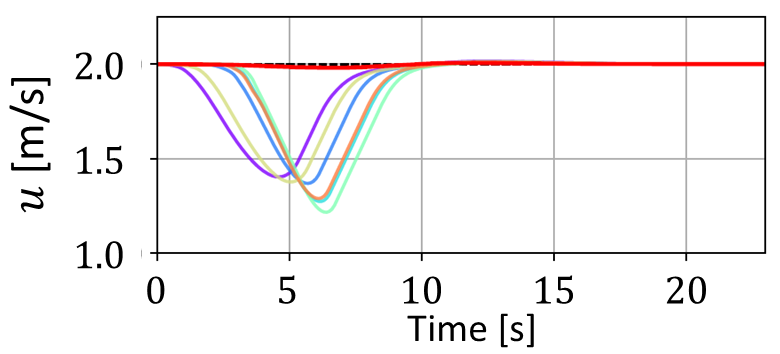 TC-CBF: no slowdown
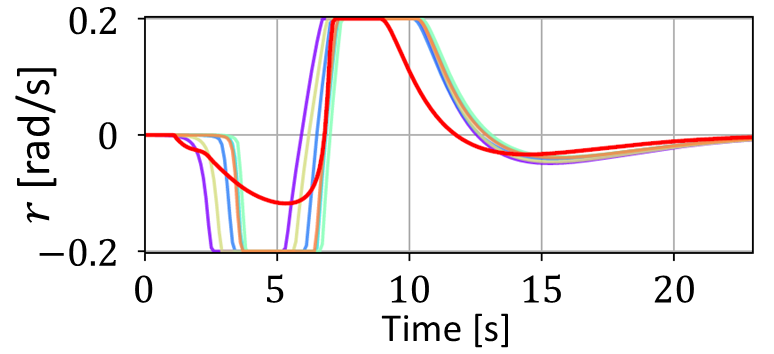
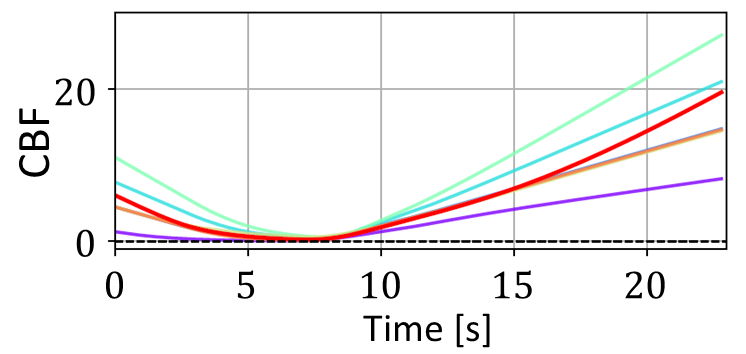
Head-on: avoidance without slowing down
TC-CBF starts a gentle turn early instead of braking hard — the oncoming obstacle is avoided at full speed
Moving obstacle approaching head-onobstacle moves from x = 25 m toward the vehicle (0 → 30 s)
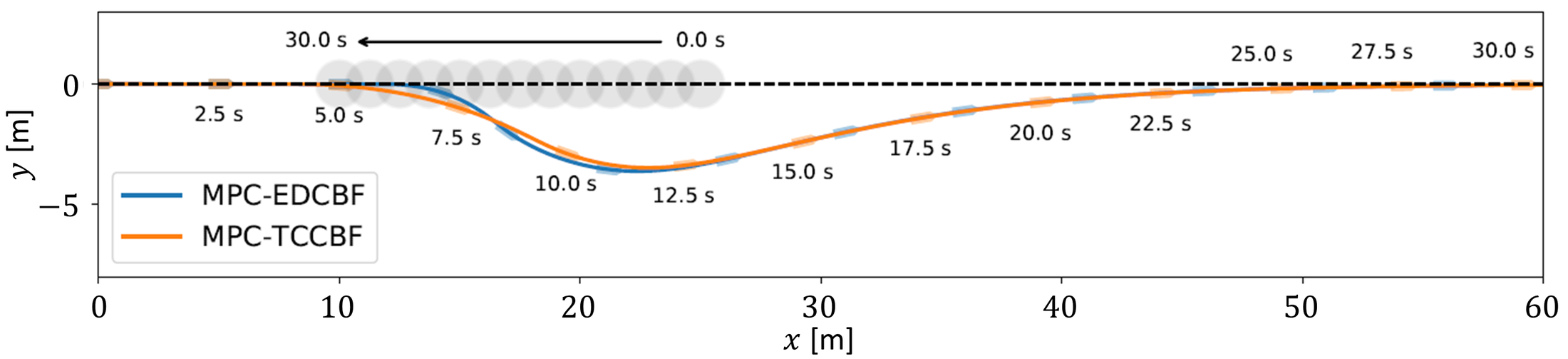
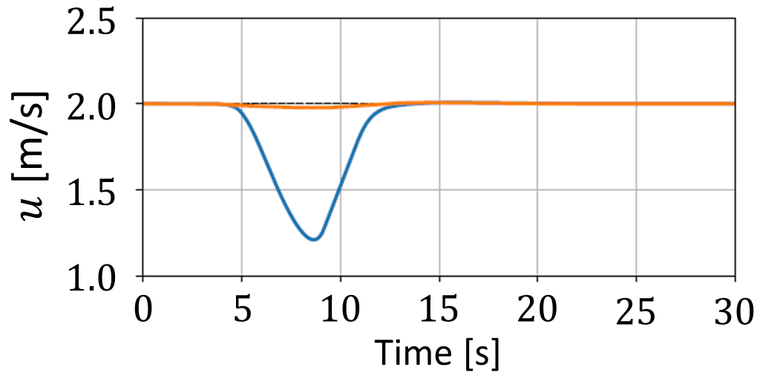 ED-CBF slows to ≈1.2 m/s
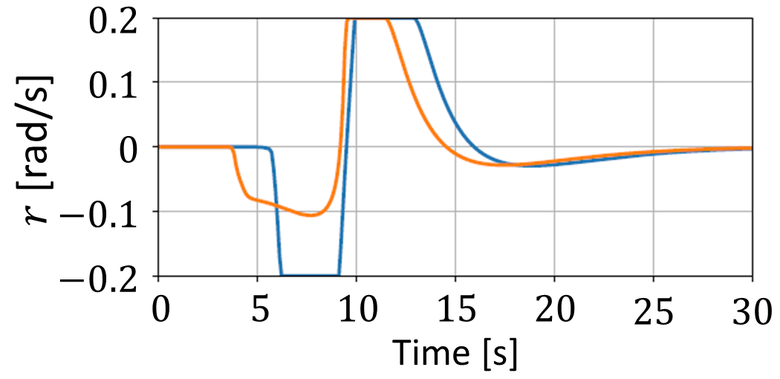 ED-CBF saturates at −0.2 rad/s
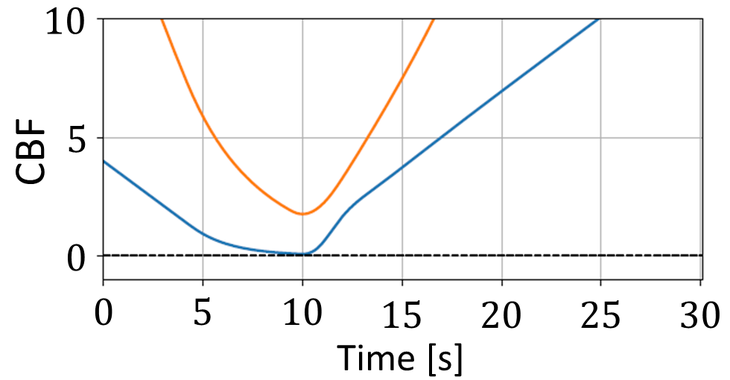 TC-CBF keeps a margin
Overtaking: a smaller detour, no slowdown
MPC-TCCBF passes with about half the lateral deviation (≈1.3 m vs ≈2.7 m) while keeping the desired speed
Overtaking a slower obstacleobstacle moves in +x along the path (0 → 20 s)
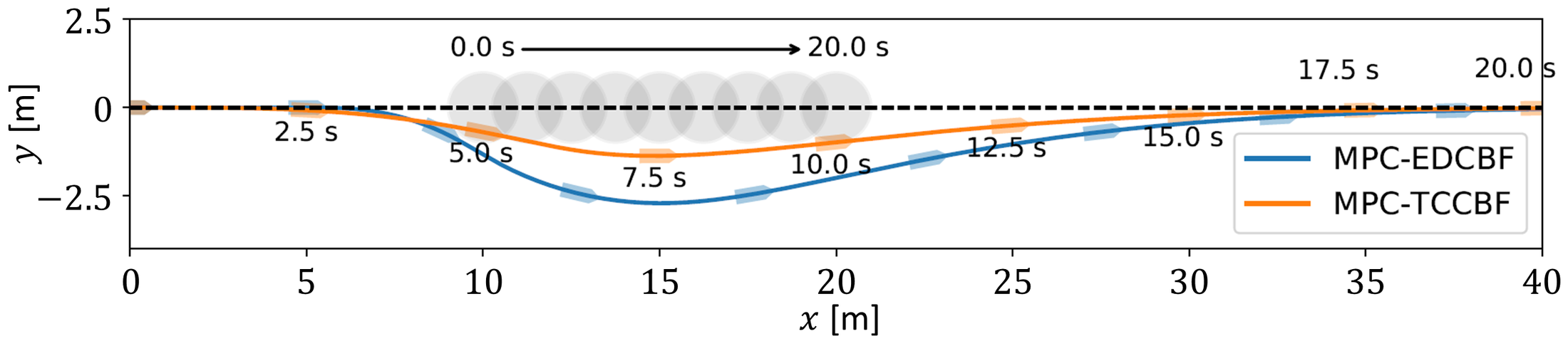
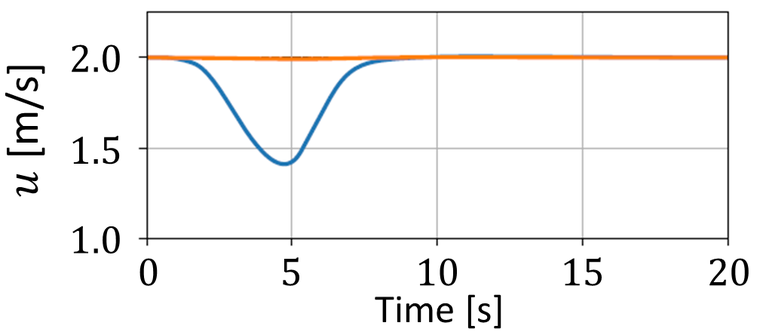 ED-CBF slows to ≈1.4 m/s
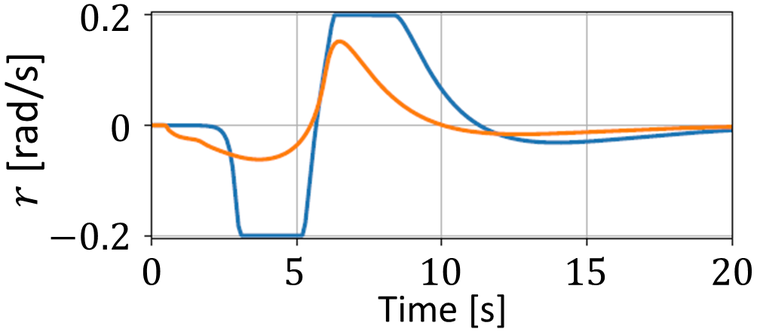 ED-CBF saturates at ±0.2 rad/s
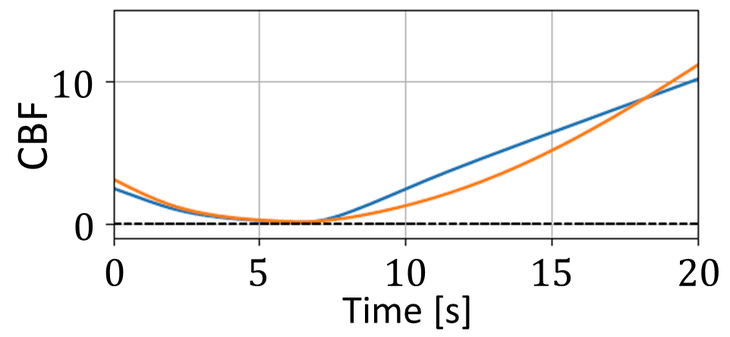
Real-world validation with an ASV
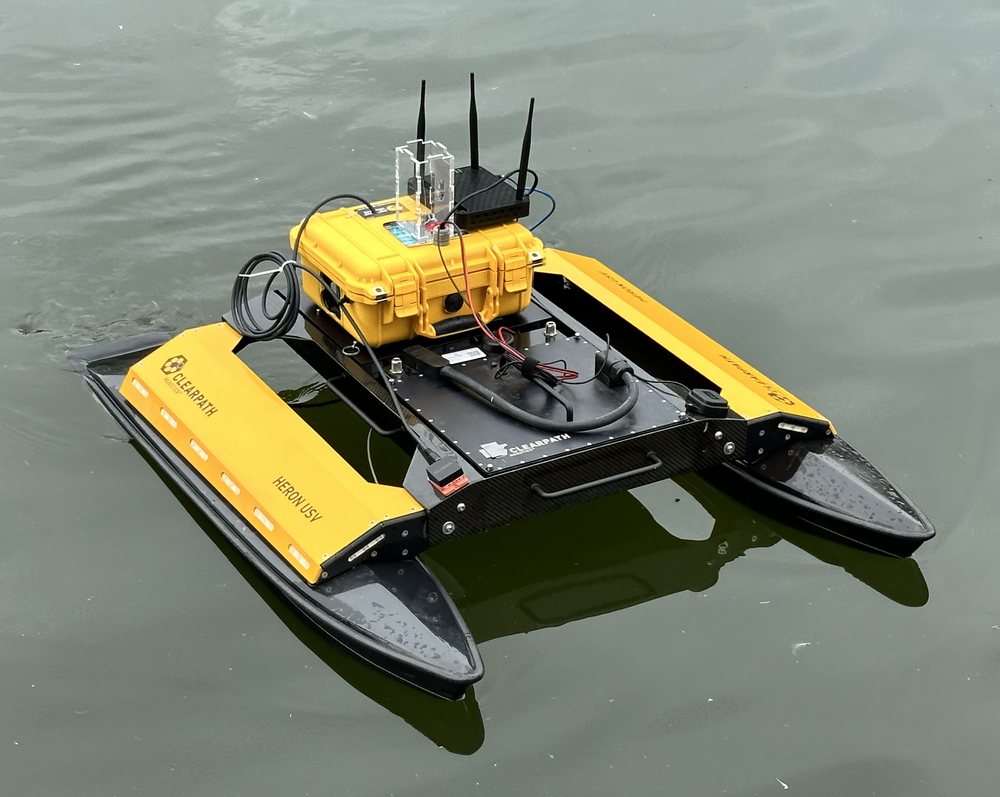

Differential-thrust catamaran ASV1.35 × 0.98 × 0.32 m · desired speed 0.9 m/s
\(M\dot{\nu}+C(\nu)\nu+D(\nu)\nu=\tau_c,\ \ \dot{\eta}=R(\psi)\nu\)\(\nu=[u,v,r]^\top\) velocities · \(\eta=[x,y,\psi]^\top\) pose
MPC-TCCBF / MPC-EDCBF: \(N=20,\ T_s=0.1\) sMPC-DC: \(N=50,\ T_s=0.2\) s · static, head-on, overtaking
Smooth avoidance with a short horizon
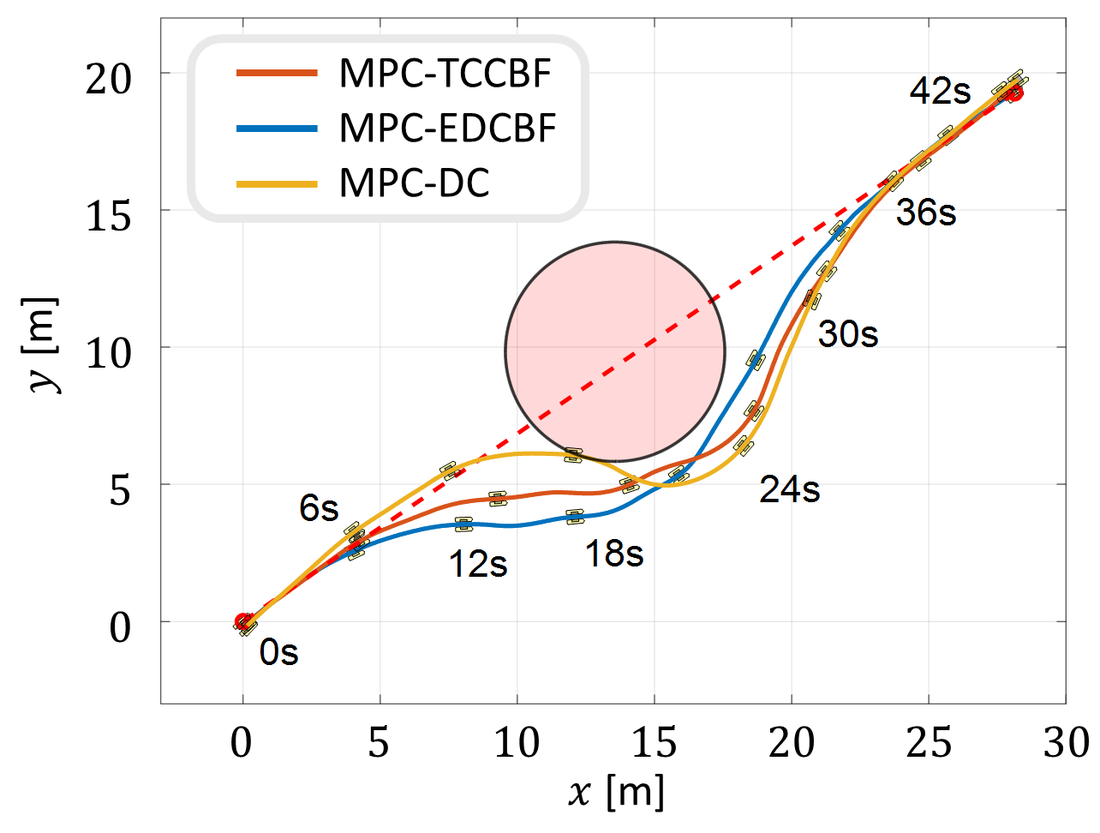
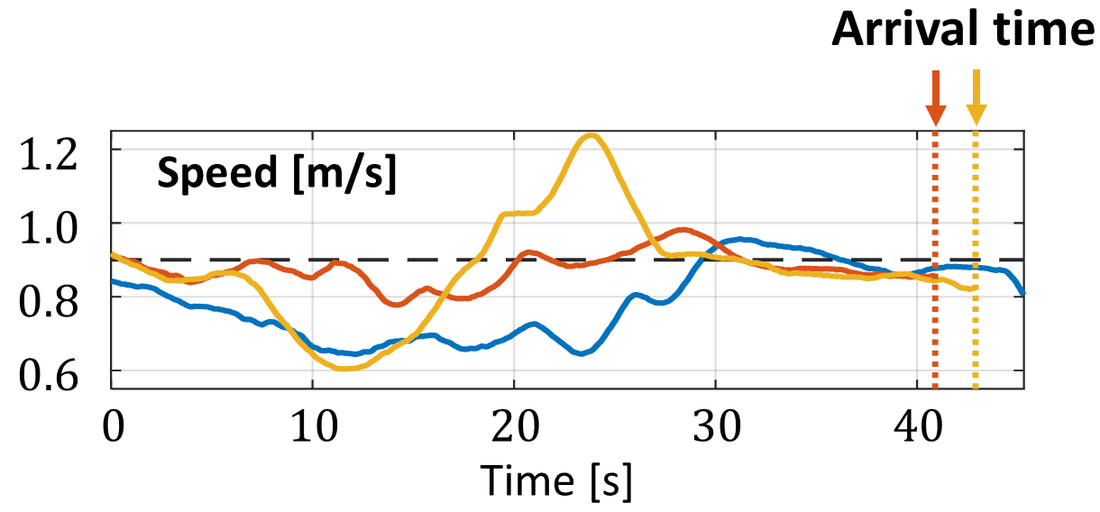
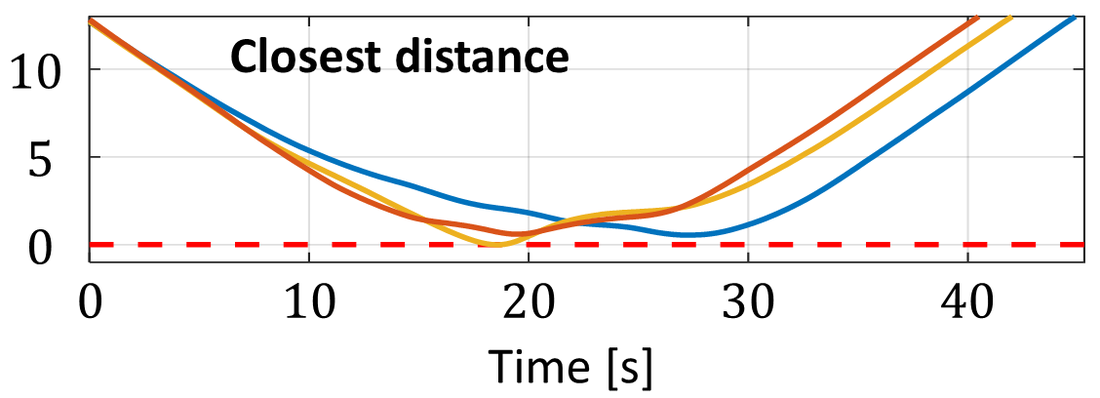
Aggressive maneuvers when close to the obstacle, even with a long horizon
Both CBF controllers avoid smoothly with a significantly shorter horizon
Arrival time 10%↓ · speed error 68%↓ · cross-track error 8%↓
Head-on: faster, closer to the path
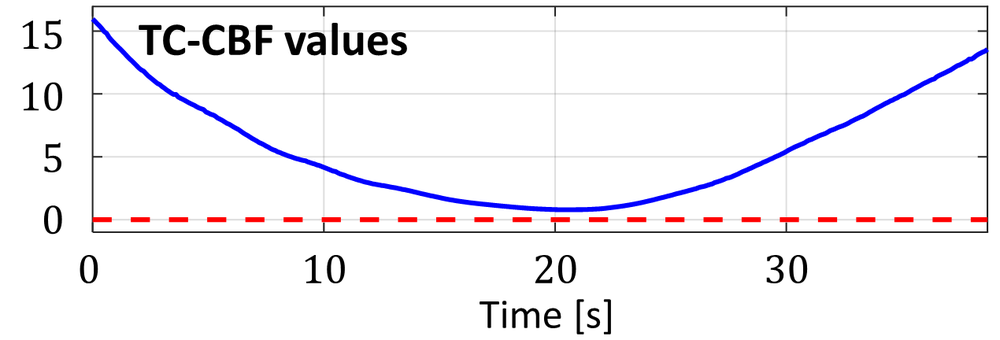
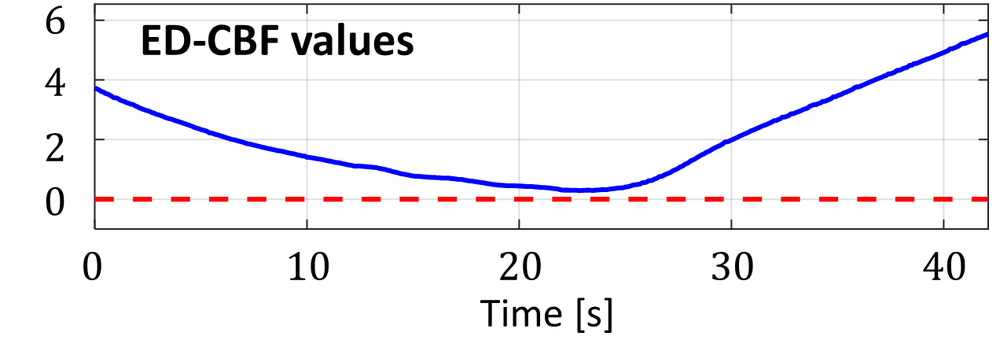
MPC-TCCBF outperforms MPC-EDCBF
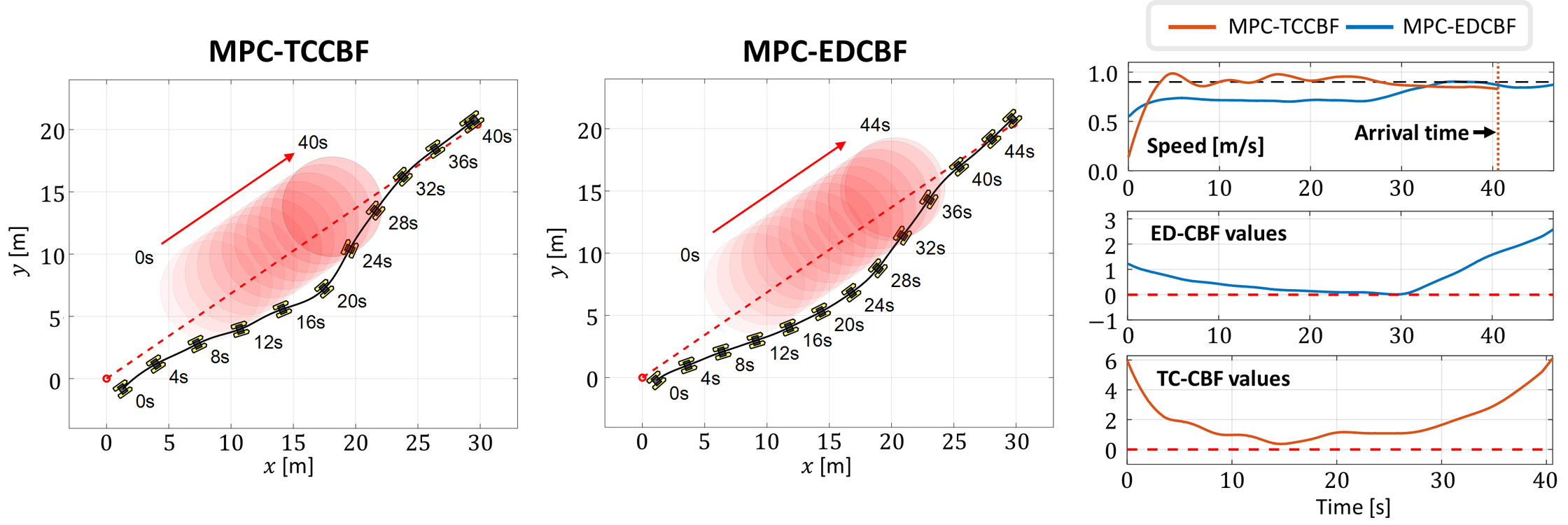
46.8 → 40.7 s
0.133 → 0.063
2.113 → 1.776


Thank you
Questions & discussion
Joint work with Kiyong Park and Jinwhan Kim (KAIST)sail-knu.github.io/Home