


IFAC World Congress 2026 · Busan
MoC32 · JO-MECH: High-Performance Motion Control Systems
15:30 – 15:50 · Paper MoC32.1
Efficient COLREGs-Compliant Collision
Avoidance Using Turning Circle-Based
Control Barrier Function
Introduction · Research background
ASVs must avoid collisions the right way
1
Guaranteeing safety is essential for autonomous surface vehicles (ASVs)
Ships that navigate and control themselves without direct human operation
2
“Maritime traffic rules”
International regulations for preventing collisions at sea (COLREGs)
They specify how each ship must maneuver when it encounters another ship
Not only avoid collisions, but avoid them in the way COLREGs require
COLREGs-compliant evasive maneuvers
Own shipTarget ship
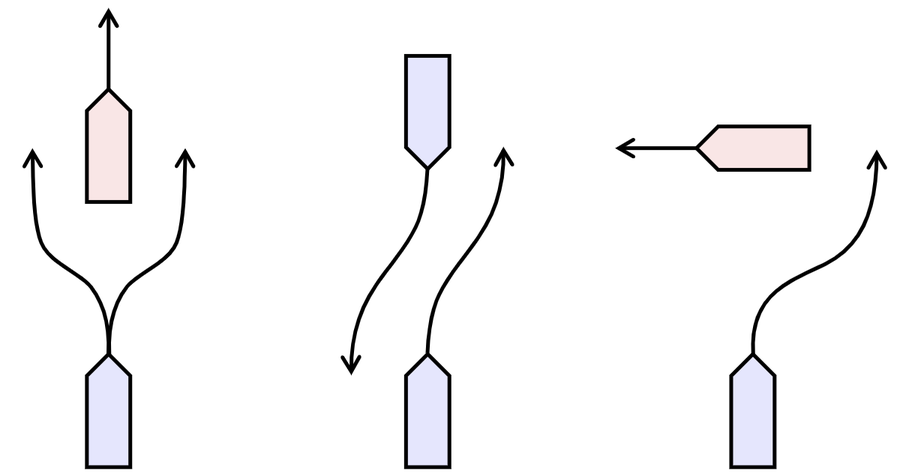
OvertakingRule 13
Keep out of the way of the ship being overtaken
Head-onRule 14
Both ships alter course to starboard
CrossingRule 15
Give-way ship turns to starboard and passes astern
Introduction · Related work
Two existing approaches, two limitations
1
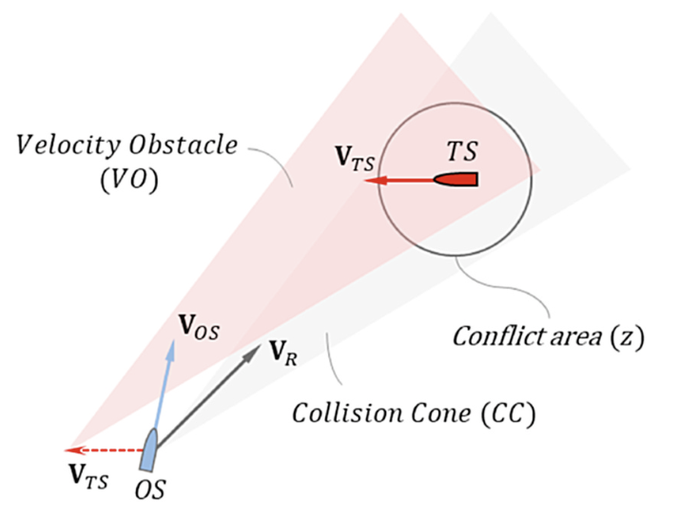
Velocity obstacle (VO)
Choose a velocity outside the collision cone
Limit
Can result in overly conservative behavior
Limits the ship’s velocity to avoid collision in compliance with COLREGs
2
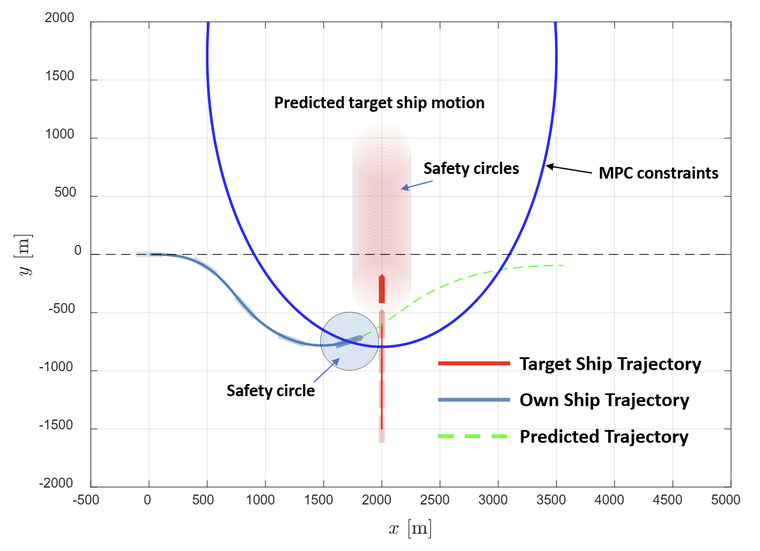
Model predictive control (MPC)
Predict motion, optimize under constraints
Limit
Outperforms VO but needs more computation
An optimization problem over the prediction horizon at every step
Research objective
COLREGs-compliant collision avoidance with MPC-level performance at high computational efficiency
Introduction · Control barrier function (CBF)
A CBF keeps the system inside a safe set
CBF
Safe set and CBF constraint
Pre-defined safe set\(h(\mathbf{x})\ge 0\)
CBF constraint
\(\dot h(\mathbf{x},\mathbf{u})+\gamma\,h(\mathbf{x})\ge 0\)
for some \(\mathbf{u}\in U\), with \(\gamma>0\): \(h\) may decrease, but never faster than the exponential bound \(\dot h=-\gamma h\), so it never crosses zero.
\(\dot h=-\gamma h\)
\(\dot h\ge-\gamma h\)
Always stays positive: safe
Collision avoidance
Distance-based CBF
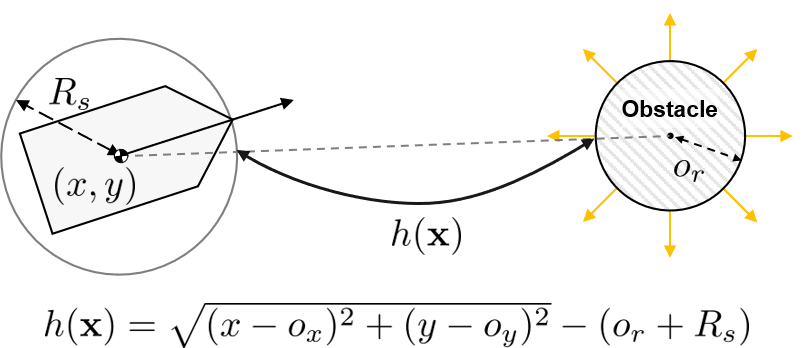
The CBF limits the speed toward an obstacle in proportion to the relative distance from it: \(-\dot h(\mathbf{x})\le\gamma\,h(\mathbf{x})\)
Introduction · Safety filter (CBF-QP)
A CBF-QP safety filter works with any controller
Nominal controllerany controller
Safety filter · CBF-QP
\[\begin{aligned}\mathbf{u}^{*}=\;&\arg\min_{\mathbf{u}\in\mathbb{R}^m}\ \|\mathbf{u}-\mathbf{u}_n\|_H^2\\ \text{s.t.}\;\;&L_f h(\mathbf{x})+L_g h(\mathbf{x})\,\mathbf{u}+\gamma\,h(\mathbf{x})\ge 0\\ &\mathbf{u}_{\min}\le\mathbf{u}\le\mathbf{u}_{\max}\end{aligned}\]
Vehicle
\(\mathbf{u}_n\)
\(\mathbf{u}\)
Compatible with any controller
Changes the nominal input as little as possible
Computationally efficient
Challenge
How to integrate COLREGs into CBFs to ensure rule compliance and improve performance?
1
Conventional CBFs lack explicit logic for avoidance direction
In COLREGs the direction is the key point: the rules tell the ship which way to go
2
They do not properly account for ships’ turning limitations
A ship cannot turn in place
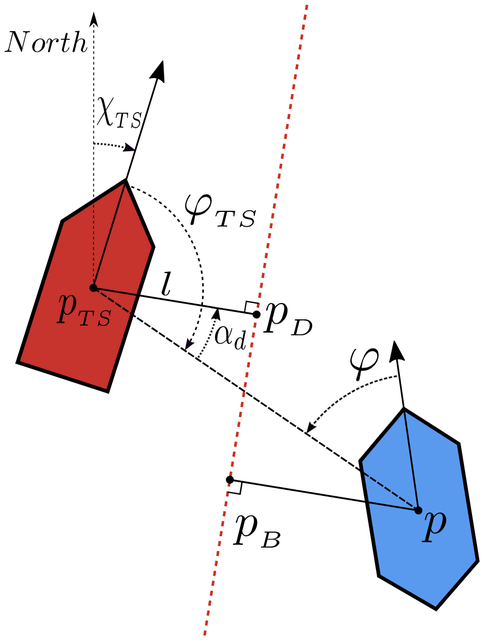
Proposed method · Visualization of TC-CBF constraints
RTC or LTC-CBF: choose the avoidance side
Nominal control input
Safe control input (filtered by TC-CBF-QP)
RTC-CBF
Right-side avoidance
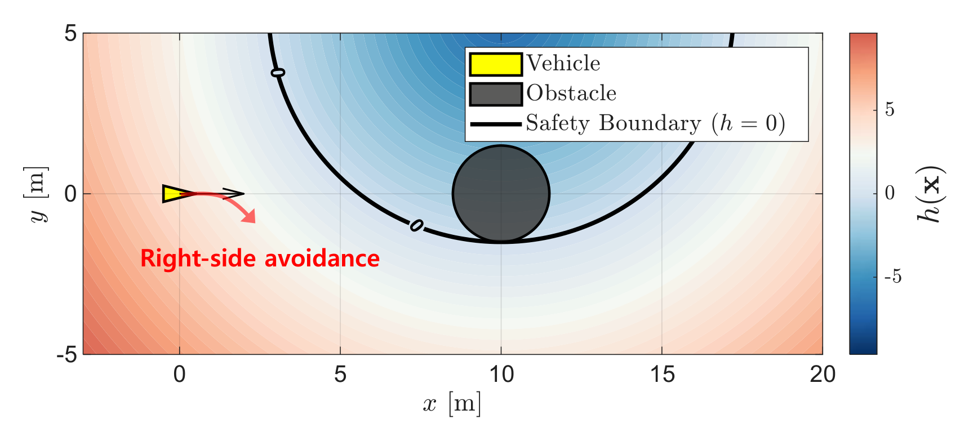
The filtered input turns the vehicle to starboard, keeping the right turning circle clear
LTC-CBF
Left-side avoidance
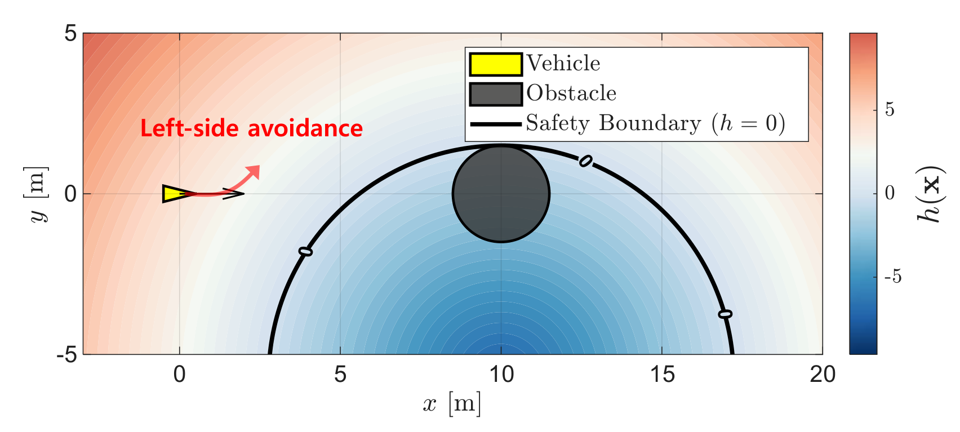
The filtered input turns the vehicle to port, keeping the left turning circle clear
By choosing the RTC-CBF or the LTC-CBF, we can explicitly choose the avoidance direction
Proposed method · Overall framework
COLREGs choose the side, TC-CBF keeps it safe
LOS guidance
+ PD control
+ PD control
Waypoint path
Safety filter · TC-CBF-QP
\[\begin{aligned}\mathbf{u}^{*}=\;&\arg\min_{\mathbf{u}\in\mathbb{R}^m}\ \|\mathbf{u}-\mathbf{u}_n\|_Q^2\\ \text{s.t.}\;\;&\dot h_{i,\sigma_i}(\mathbf{x})+\gamma_i\,h_{i,\sigma_i}(\mathbf{x})\ge 0,\quad i=1,\dots,n\\ &\mathbf{u}_{\min}\le\mathbf{u}\le\mathbf{u}_{\max}\end{aligned}\]
ASVown ship
Decision makingCOLREGs rules
Traffic ship \(i\)\(i=1,\dots,n\)
\(\mathbf{u}_n\)
\(\mathbf{u}\)
\(\mathbf{r}\)
\(\mathbf{x}\)
\(\sigma_i\in\{\mathrm{L},\mathrm{R}\}\): LTC- or RTC-CBF chosen for each traffic ship
Decision-making module
COLREGs encounter classification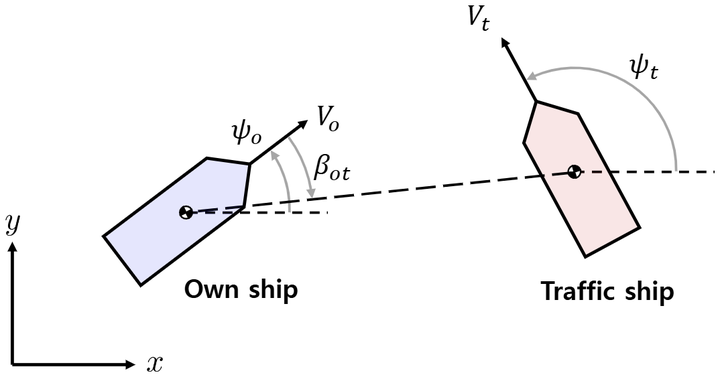
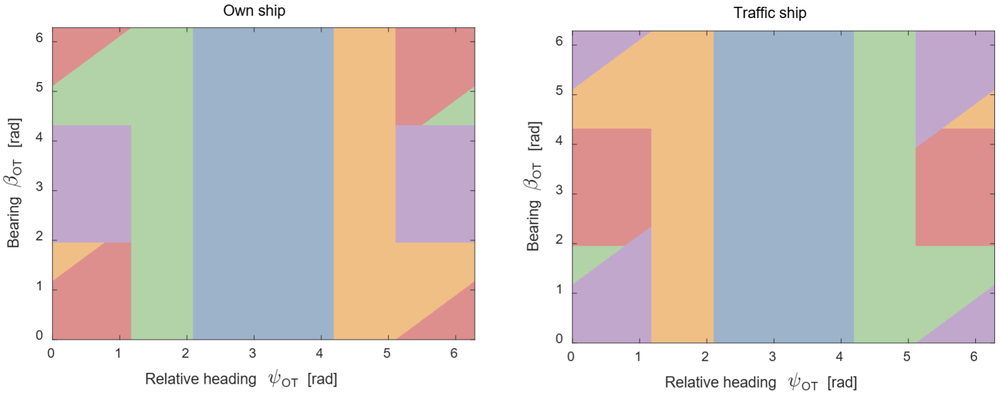
Head-on
Starboard crossing
Overtaking
Port crossing
Overtaken
Classifies each traffic ship by bearing \(\beta_{OT}\) and relative heading \(\psi_{OT}\), then applies only the constraint for the side the rule requires
e.g., head-on → alter course to starboard → RTC-CBF
Results · One-to-one encounter simulations
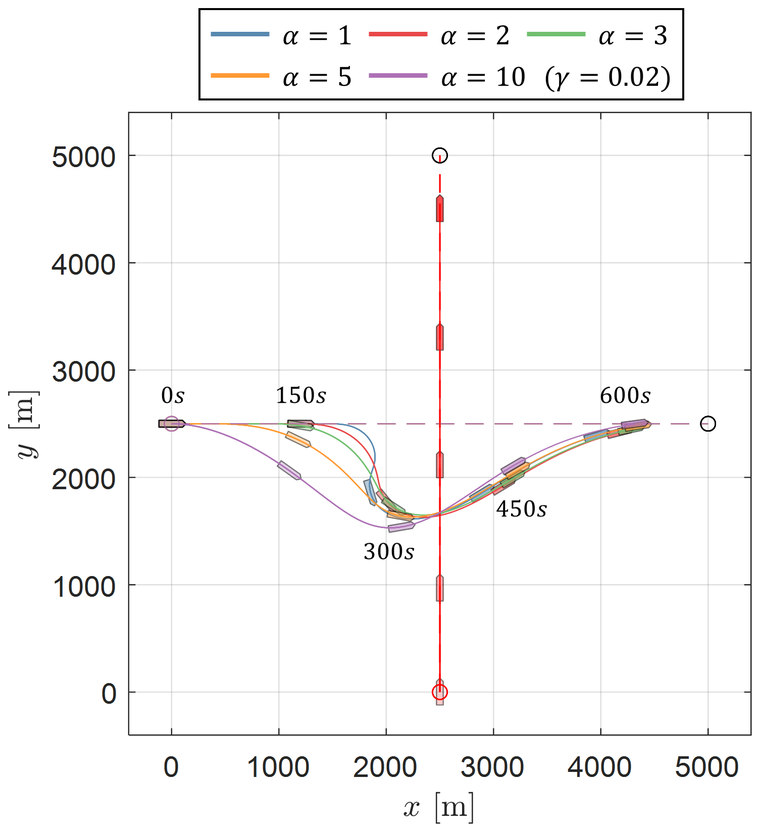
Tuning \(\alpha\) and \(\gamma\): when and how wide to avoid
Turning-circle scale \(\alpha\)fixed \(\gamma=0.02\)
CBF parameter \(\gamma\)fixed \(\alpha=5\)
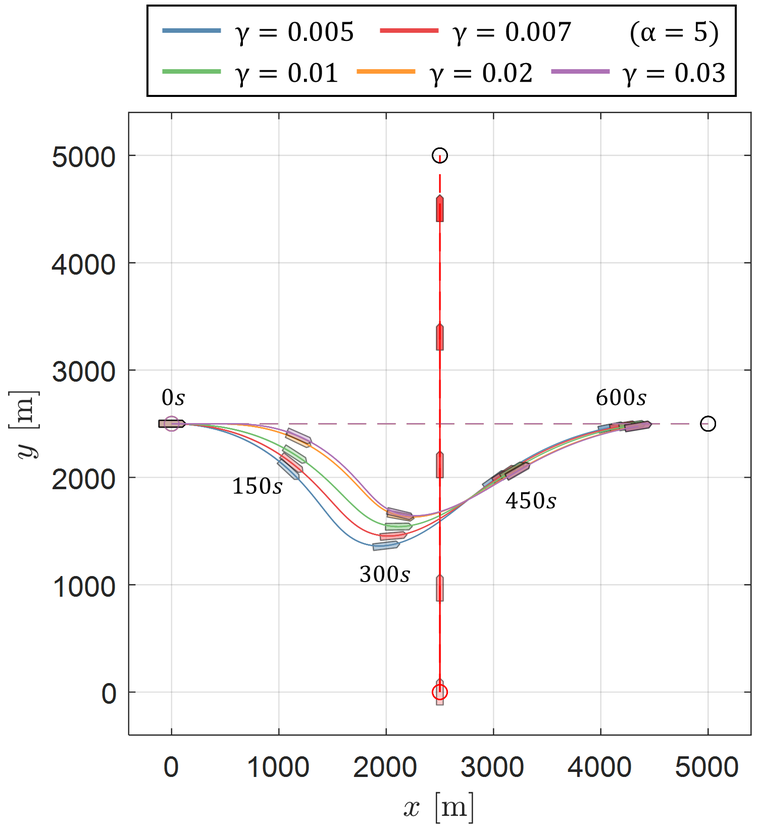
Scenario
Starboard-crossing encounter
The traffic ship (red) crosses from the starboard side; the own ship gives way by turning to starboard and passing astern. Snapshots every 150 s.
\(\alpha\uparrow\)
Larger turning circle → earlier and smoother avoidance
\(\gamma\downarrow\)
More conservative constraint → larger avoidance distance
Results · Multi-ship encounter simulation · own ship + 6 traffic ships
Comparable to MPC, 167× faster on average
Proposed (TC-CBF-QP)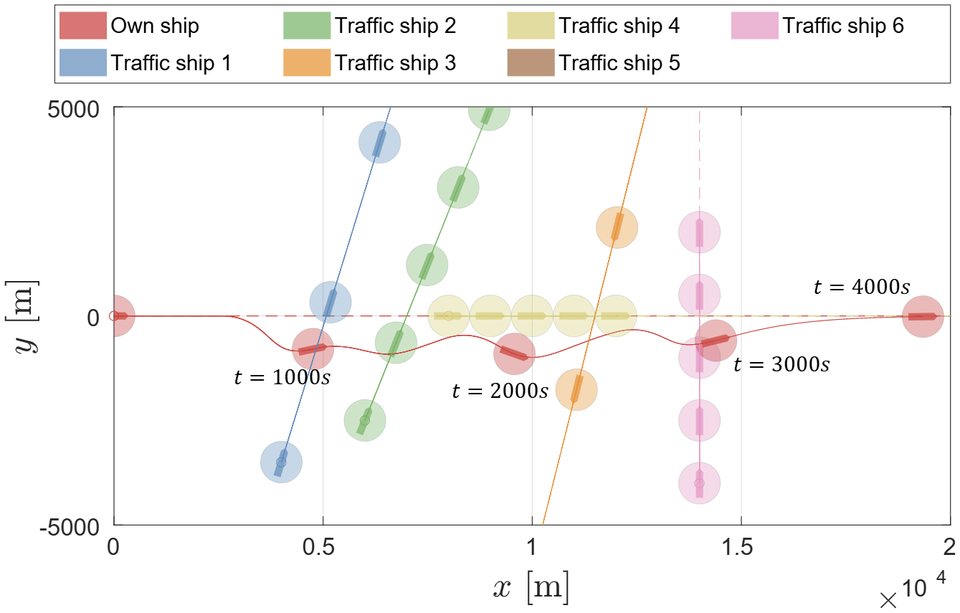
MPC-based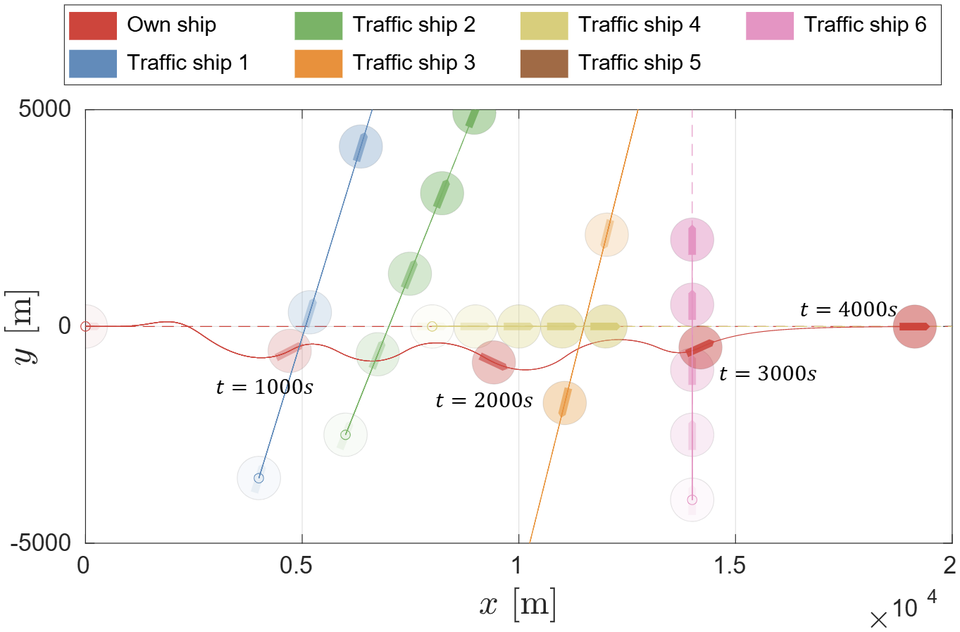
167×
faster on average
23.35 → 0.14 ms
23.35 → 0.14 ms
−29%
control effort
8.66 → 6.16
8.66 → 6.16
| Controller | Avg. comp. time* | Max. comp. time | Avg. CTE | Max. CTE | Control effort** |
|---|---|---|---|---|---|
| Proposed (TC-CBF-QP) | 0.14 ms | 1.80 ms | 439.5 m | 992.4 m | 6.16 |
| MPC-based | 23.35 ms | 40.18 ms | 390.6 m | 1001.2 m | 8.66 |
Bold: better · CTE: cross-track error from the reference path · both methods avoid all traffic ships and return to the path
Results · Multi-ship encounter simulation · four ships crossing at the center
Four ships at once: 140× faster than MPC
Proposed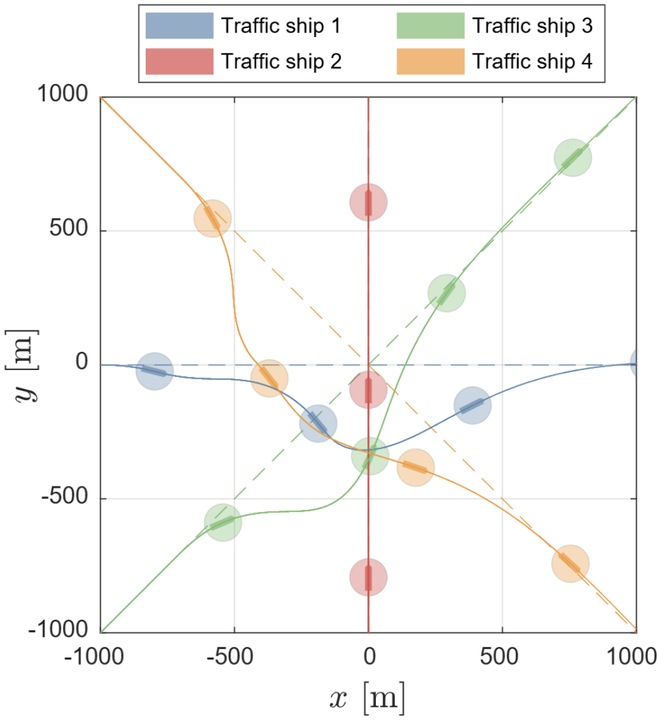
MPC-based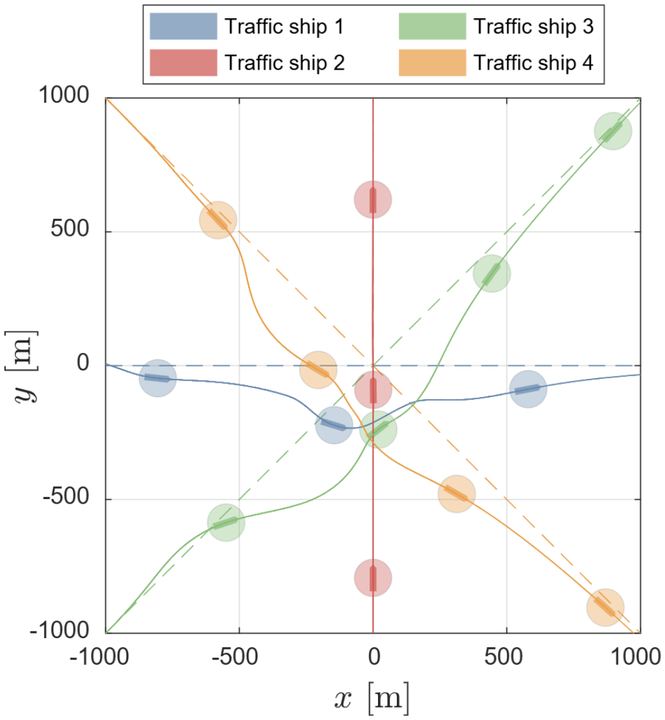
Proposed · animation
140×
faster on average
12.60 → 0.09 ms
12.60 → 0.09 ms
−20%
control effort
15.29 → 12.25
15.29 → 12.25
| Controller | Avg. comp. time* | Max. comp. time | Avg. CTE | Max. CTE | Control effort** |
|---|---|---|---|---|---|
| Proposed (TC-CBF-QP) | 0.09 ms | 1.62 ms | 61.4 m | 228.6 m | 12.25 |
| MPC-based | 12.60 ms | 38.70 ms | 52.9 m | 164.9 m | 15.29 |
Bold: better · MPC tracks the path slightly better (lower CTE), while the proposed method needs less control effort
Thank you
Questions & discussion
✉️ leeck@kongju.ac.kr
Changyu Lee · Kongju National University
Additional papers applying TC-CBF
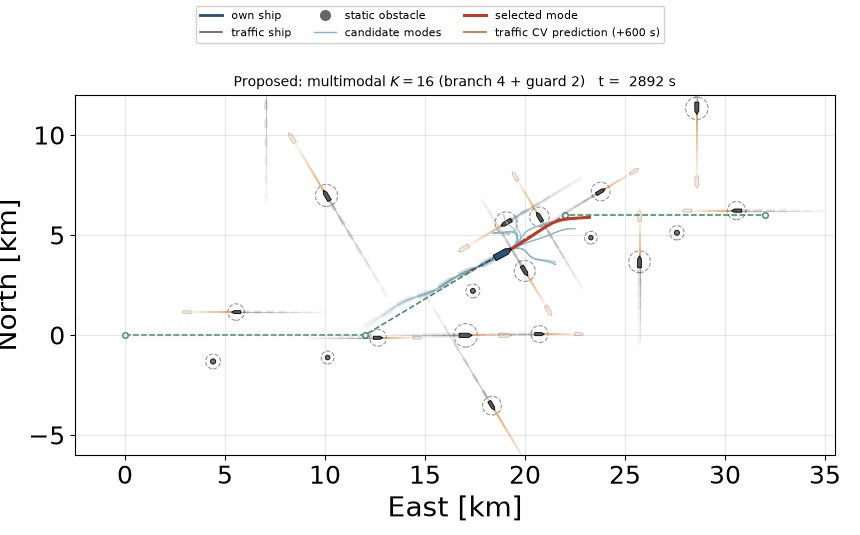
Under review
Multimodal Trajectory Planning for Surface Vehicles using Turning Circle-based Control Barrier Function
Changyu Lee*
This talkChangyu Lee, Jinwook Park, Jinwhan Kim*, “Efficient COLREGs-Compliant Collision Avoidance using Turning Circle-based Control Barrier Function,” Mechatronics, 2026 · DOI · arXiv